
Sent it. Surely someone's reading this, right?
The gatekeeper you never see
Before a recruiter ever opens your resume, software already decided whether they will. 97.8% of Fortune 500 companies now run every application through an applicant tracking system (ATS) before a person looks at it, according to Jobscan's annual audit of Fortune 500 hiring pages. That number has held above 97% every year since 2018. This isn't a niche corporate quirk anymore — it's the default front door for most mid-size and large employers, and increasingly for smaller ones too.
An ATS doesn't reject you because it dislikes your experience. It rejects you because it couldn't read your experience correctly, or because the words on your resume don't overlap enough with the words in the job posting. Those are two very different, very fixable problems — but only if you understand what the system is actually doing.
What the ATS is actually checking
Most systems do two things before a human ever gets involved: parsing and matching.
Parsing means the software extracts your resume's raw text and tries to sort it into structured fields — name, job titles, dates, skills, education. If your resume uses multi-column layouts, text boxes, tables, headers/footers, or graphics for section titles, many parsers either scramble the reading order or drop that content entirely. A recruiter searching for "Python" won't find you if your skills section lived inside a text box the parser never opened.
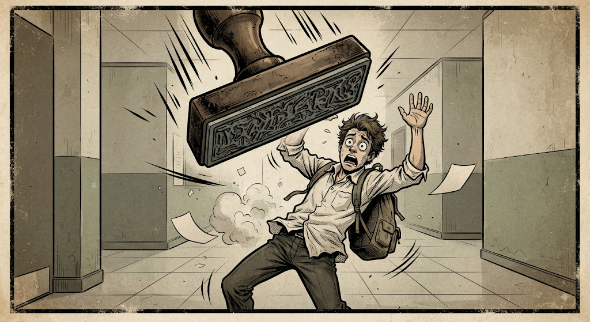
Seven seconds. Never even met a human.
Matching means the system scores how closely your resume's language mirrors the job description's language. This is where qualified candidates lose the most ground. You might have done the work — managed a budget, led a team, built a dashboard — but if the posting says "stakeholder management" and your resume says "worked with clients," the keyword match often fails even though the substance is identical.
The specific mistakes that trigger a silent rejection
- Non-standard section headers. "My Journey" instead of "Experience," or "What I Bring" instead of "Skills" — creative headers that a human would understand instantly can go unrecognized by a parser looking for standard labels.
- Tables, columns, and text boxes. They look clean to your eye and unreadable to a parser, which often reads left-to-right across the whole page rather than down each column.
- Keywords that exist but don't match. Having the skill isn't enough if the phrasing doesn't overlap with the posting — "JS" versus "JavaScript," "PM" versus "Project Manager."
- Wrong file type. If a posting specifies PDF or DOCX, submitting the other format — or a scanned image saved as a PDF — can mean the parser extracts nothing usable at all.
- Dense, unbroken paragraphs. Long blocks of prose bury the specific nouns and verbs a matching algorithm is scanning for.
How to check before you apply again
You don't need to guess whether any of this applies to you. Run your resume against the actual job description you're targeting and look at two things: does the parsed text come back complete and in the right order, and which specific keywords from the posting are missing from your resume. Add the missing ones only where they're true — don't pad phrases you can't back up in an interview. Then simplify the formatting: standard headers, no tables, no text boxes, no graphics carrying information a person needs to see.
None of this requires rewriting who you are. It requires making sure the system reading your resume first can actually read it — so the recruiter reading it second gets the chance to.

Match the words, beat the bot, meet the human.
If you want to know exactly where your resume stands before you hit submit again, that's what Resume Check tells you in under a minute.
Try Resume Check free at ATOLIQ →
What is ATOLIQ?
ATOLIQ
is a free AI career readiness platform built on one idea: getting an interview
isn't one fix, it's four. Resume Check and
Role Match
show you exactly where you stand against a job. The
Skill Gap Planner
and Proof Builder
turn gaps into a plan and real evidence. OptiResume, AI Resume Rewrite, and the
LinkedIn Profile Optimizer
make sure the words on the page actually land. Start at
atoliq.com.


Comments
Post a Comment